
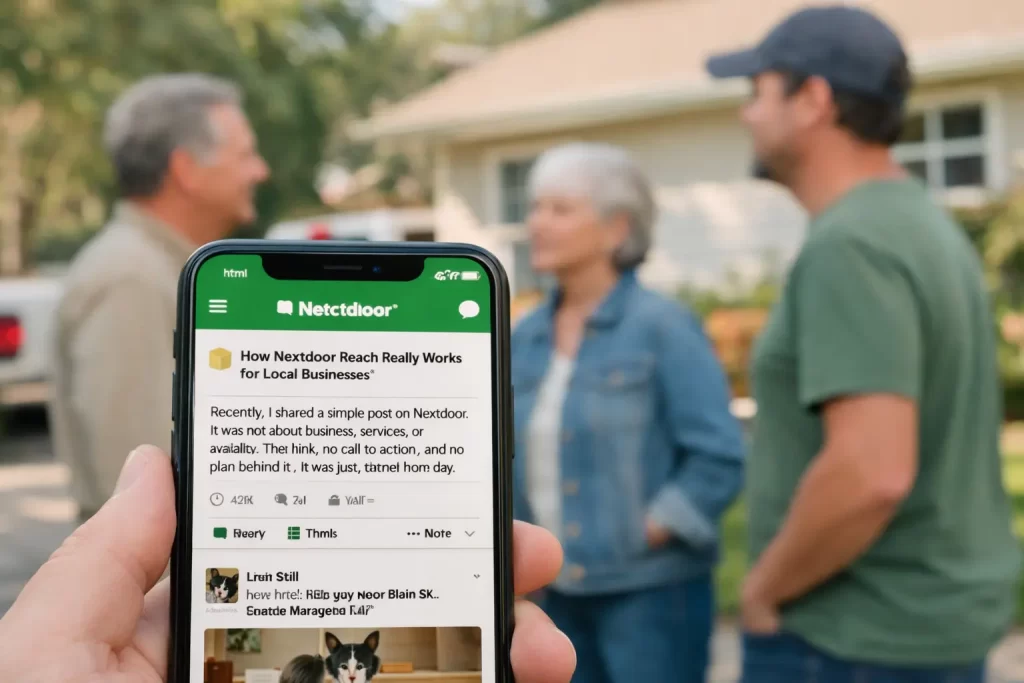
Recently, I shared a simple post on Nextdoor that had nothing to do with my business, my services, or my availability. There were no links, no call to action, and no intention behind it beyond sharing something in the moment.
What happened afterward surprised me. The post continued to receive reactions and comments well beyond the first day, and views kept climbing instead of dropping off the way most local posts do.
That experience matters for local business owners who feel unsure about how Nextdoor actually works.
It is the kind of real-world behavior I pay attention to when shaping strategy at Gagne Marketing.
What Most Businesses Get Wrong on Nextdoor
Many businesses approach Nextdoor the same way they approach Facebook or Instagram.
They lead with service descriptions, credentials, and long explanations of what they do.
On a neighborhood platform, that approach usually creates friction.
Promotional language stands out immediately, and long comments feel more like pitches than participation.
Neighbors are not scrolling to shop or compare options. They are scrolling to see what is happening nearby, which is why detailed service explanations belong on a website, such as a focused web design page, rather than inside a neighborhood feed.
What Actually Drove Reach and Engagement
The post that performed well did not ask for anything or explain anything.
It required no decision, no commitment, and no follow-up from the reader.
It was community-first content that felt emotionally neutral and easy to interact with. People could react or comment without feeling like they were stepping into a conversation or making a choice.
That ease of interaction matters more than most people realize. When engagement feels effortless, more people participate, which is what keeps a post circulating. This is also why trust signals matter more than clever wording in local SEO.
The Role of Timing and Availability
Timing played a bigger role than polish. Being present while neighbors were actively posting mattered more than having a carefully crafted message.
Many Nextdoor posts are driven by immediate needs. Someone is looking for help right now, not researching options for later.
In those moments, availability often outperforms credentials. People respond to whoever feels familiar and present when the need appears. That same behavior is why I focus heavily on Google Business Profile optimization alongside website work.
From Visibility to Real-World Results
Engagement on its own does not matter if it never leads to action. What gives it value is familiarity built over time. When neighbors see the same name appear naturally in conversations, hesitation drops.
Trust builds quietly, without forcing attention or promotion.
When a real need comes up, decisions happen faster because the groundwork has already been laid.
Organic visibility removes friction in a way paid or forced exposure rarely does.
Why This Matters for Local Marketing Strategy
This experience reinforced several important truths. Posting more often does not guarantee visibility, and promotion does not automatically build trust. Neighborhood platforms reward human behavior, not optimization tricks. They amplify what feels natural, timely, and appropriate for the space.
Sustainable reach comes from relevance, not frequency. That includes how you show up, when you show up, and whether your presence feels earned. This is why I help businesses build consistency through
AI consulting in Manatee County.
Key Takeaway
Nextdoor works best when it is treated like a neighborhood instead of a marketing channel.
Showing up as a person first makes everything else easier.
Be helpful when help is needed, participate naturally, and share things that feel safe and easy to react to.
When that happens, the platform usually does the rest.
Closing Thought
Some of the most useful marketing lessons come from observation rather than strategy.
Paying attention to how real people behave in real spaces often teaches more than any framework ever could.