
A Contractor’s Monday Morning Problem
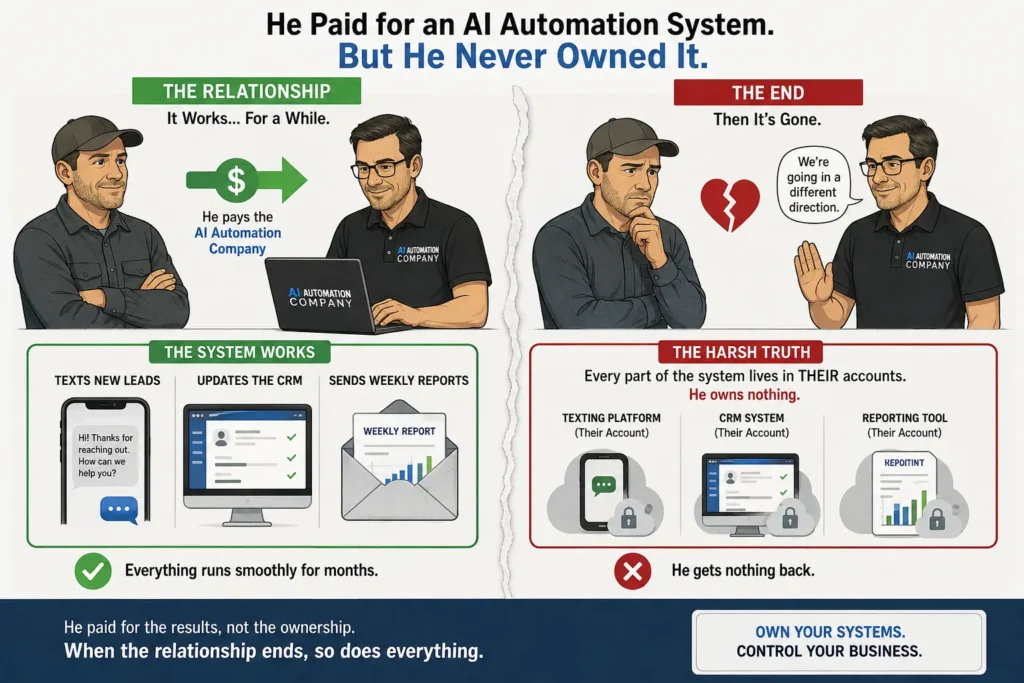
Picture a contractor who pays an AI automation company to text new leads, update his CRM, and send weekly reports. It works fine for months. Then the relationship ends, and every piece of that system lives inside the company’s own accounts, not his. He never gets any of it back.
New leads stop getting a response. He doesn’t find out until a customer complains about being ignored.
I made that example up, but I hear pieces of it constantly. It happens when a business owner never asked one question up front: who holds the keys to this?
What Vendor Lock-In Means
The plain term for this is vendor lock-in. It means the company you hired holds enough control over your accounts, your data, and your workflows that leaving them costs more than staying, even once you want to leave.
Most AI automation companies aren’t doing this on purpose. They build inside their own workspace because it’s faster for them. Training was never part of the deal. Nobody wrote down a handoff plan. That isn’t malice. It’s still a real problem for the business paying the bill.
This matters more if you’re a solo owner or a small team. A bigger company might have someone in-house who can untangle a messy system on their own. Most of the small businesses I work with in Manatee County don’t have that person. If the only place the knowledge lives is inside someone else’s company, that gap becomes your risk, not theirs.
Warning Signs You Are Being Set Up to Stay
A few signs point to a company that wants you dependent, not just one that never got around to documentation.
- The system runs inside their personal accounts instead of a company account with your business name on it.
- You don’t have admin access or login details for the tools they built.
- Questions about how something works get answered with “that’s too complex to explain.”
- There is no written guide, video walkthrough, or system map anywhere.
- The contract charges a large fee if you leave or bring the work in-house.
What a Fair Company Does
None of this means every ongoing service relationship is a trap. A company can reasonably manage your system day to day. Charging separately for training or a migration is fair too.
What isn’t fair is hiding who owns the accounts, the data, and the exit path. Managing your system for you is fine. Making sure you can never leave is not the same thing, even if it gets pitched as the same thing.
A useful test: if you had to walk away tomorrow, could you? If the honest answer is no, that’s a real gap to close now, before something forces the issue.
What to Ask For Before You Sign
A little homework up front saves a lot of pain later.
- Ask that every tool account, like Zapier, Make, or OpenAI, gets created under your business email, not theirs.
- Ask for full admin access starting day one, even if you never plan to log in yourself.
- Put a transfer clause in the contract. If the project ends, they hand over your data and how the system works.
- Pay for real training, not just a login and a goodbye. A short walkthrough of the basics pays off the first time something breaks.
A Comparison Most Trades Owners Already Know
Think about a tractor. You own the machine, but only the dealer has the diagnostic tool and the access code to fix it. That frustration is familiar to a lot of landscaping, HVAC, and farm-adjacent business owners already.
It’s the same problem with a website or an AI system. Owning the equipment doesn’t mean much if only one company can run it.
Getting Help Does Not Mean Losing Control
I don’t build automations myself. I look at how a business runs day to day and tell you what fits and what doesn’t, including if the company pitching you deserves your trust. That applies if you’re deciding on hiring an AI automation company in the first place, and it applies just as much if you already have one running and nobody on your team knows how to touch it.
If you want the fuller picture on choosing between a consultant and a vendor, I wrote about that difference in AI consulting versus AI automation. And if you’re curious what it looks like to build tools you keep control of, I walked through my own setup in how I actually run my business with AI.
You can reach out through my contact page if you want to talk through what any of this looks like for your own business.